


Does this healthcare work need a trained model?
Aranv builds a custom LLM for healthcare paperwork: a large language model (LLM) fine-tuned on your reviewed notes, letters and coder corrections to structure documentation, draft prior authorization letters and suggest codes. It never makes diagnosis or treatment decisions, and a clinician or coder reviews every output.
Start with what is already available. A careful prompt plus retrieval may handle much of this, and our page on prior authorization shows that route. We look to train your own AI model only when your format, phrasing and coding habits are the gap. Even then we begin from open-weight base weights, since training from zero rarely makes sense.
A trained model carries behavior, not facts that change. Payer criteria, coverage rules and code updates belong in retrieval. Reviewed examples are prepared through our training data service, and your documents are used for your model.
From reviewed documents to drafts a person signs
How a documentation model is trained and checked
- 01 Agree the rules first Your compliance lead settles hosting, access, de-identification and vendor terms before the build.
- 02 Choose teaching documents Coders and documentation staff pick audited notes, letters and coding corrections.
- 03 Tune on the reviewed set Open-weight base weights learn your section order, phrasing and letter structure.
- 04 Test against the chart A claim in a draft that does not trace to the record fails.
This work covers documentation and administration. Diagnosis and treatment decisions are outside it and stay with clinicians.
What a medical LLM can learn from paperwork
Retrieval can find a payer rule. It does little to teach a model how your departments organize a note or how your staff present a case.
-
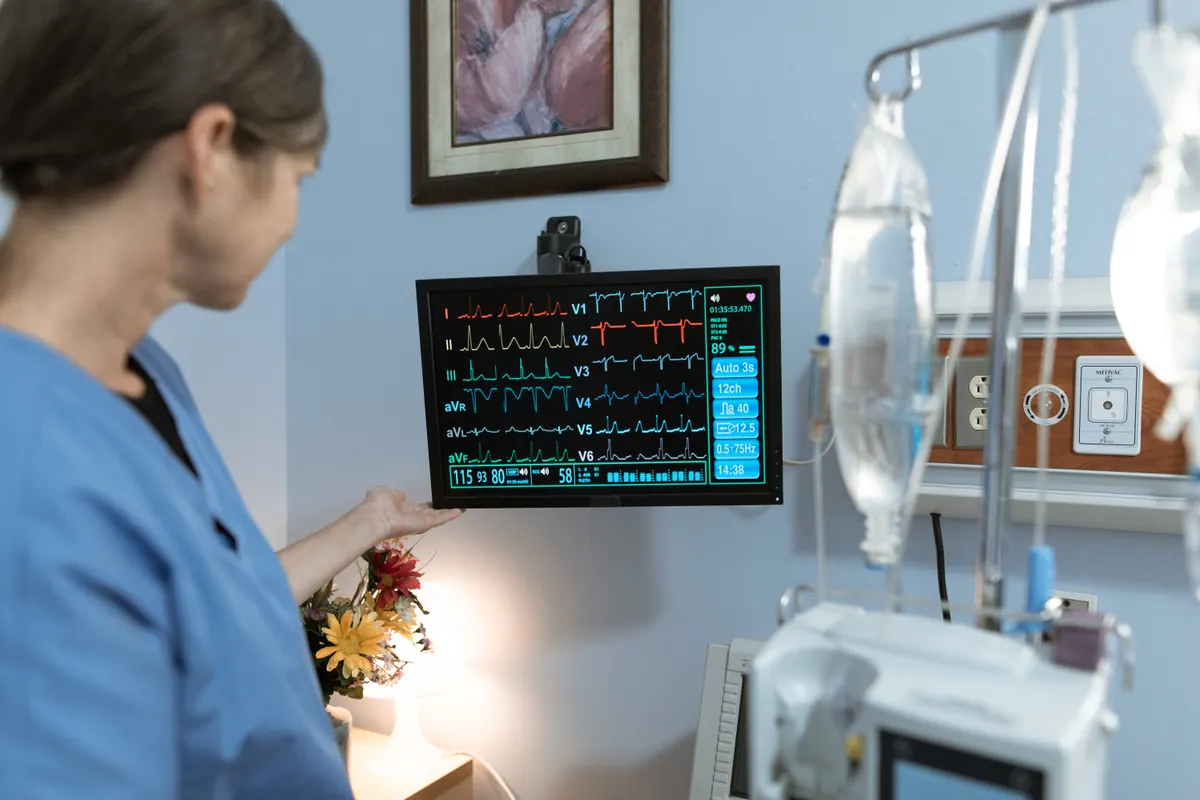
Notes in your sections
Dictated or free-text visit notes are arranged into the section order each specialty uses, adding nothing the clinician did not say.
-

Prior authorization letters
Drafts follow how your coordinators present chart history for each service line, while payer criteria come from retrieval and a person signs.
-
Code suggestions for coders
Suggested codes appear beside the supporting note text, so a coder confirms or rejects each one against the current code set.
-

Documentation queries
When a note lacks detail, the model drafts a neutral clarification question for your documentation specialist, without steering the clinician to an answer.

De-identification before anything is trained
Clinical notes are hard to clean, because identifiers hide in free text: a daughter’s name, an employer, a date mid-sentence. HIPAA requirements shape hosting, access, de-identification and vendor agreements when a project handles protected health information, and these are agreed with your compliance lead before the build.
What we do
- Identifier review of free-text samples
- Method chosen with your compliance lead
- Access limits for the training team
- Hosting decided before any data moves
Failure modes we test for
Documentation models fail in specific ways. They add a symptom that would support a letter, repeat copied-forward text, or learn billed codes that an audit later corrected. Our tests include notes with a fact removed, to confirm the model reports the gap instead of filling it.
What we do
- Missing-fact tests on real note types
- Added-claim check against the chart
- Audited codes, not only billed codes
- Results split by specialty

How we approach a project
Where the model runs is a decision for your compliance lead, and private deployment in your own cloud or servers is one option. We make no claim of HIPAA certification, and nothing here is legal advice. Read the text of 45 CFR 164.514 with your counsel before any export.
This sits beside wider software work for healthcare, with your EHR staying the system of record. Bring one document type to a 30-minute conversation; our contact page has the booking link.
How we work
- Documentation only, never diagnosis
- Every draft statement traces to the chart
- Coders confirm codes, clinicians sign notes

How a healthcare model project runs
-

Pick one document type
We begin with a single type, such as a prior authorization letter for one service line.
-

Agree the data path
Your compliance lead and our team settle the de-identification method, access and hosting.
-

Baseline, license check, tuning
Prompts plus retrieval go first. If they fall short, we read the base license and tune.
-

Supervised use in one department
Coders or coordinators use drafts on live work and record each change they make.
Why Aranv for healthcare models
Scope limits written in advance
We write down which documents the model may draft, and that clinical decisions are excluded, so nobody has to interpret it later.
Labels come from audited work
Code suggestions train on coder-corrected records rather than raw billing history, so past billing errors are less likely to become habit.
We look for invented detail
Drafts are compared with the chart statement by statement, because a persuasive letter with an unsupported clinical claim is worse than none.
The baseline can win
If prompts plus retrieval do as well as a tuned model on your own documents, you keep the simpler setup and we say so.
Planning Custom LLM for Healthcare?
Book a 30-minute conversation with the team that would build it.
Custom LLM for Healthcare FAQs
-
Can we train AI on clinical notes?
Yes, if your compliance lead approves the data path first. Free text needs closer review than structured fields, because identifiers hide in sentences. Copied-forward and poorly documented notes come out too, since they teach bad habits.
-
Can a custom model suggest a diagnosis or treatment?
No, we do not build that. This service covers documentation and administrative work. If a draft seems to imply a clinical judgment, the reviewer removes or corrects it, and clinical decisions stay with clinicians.
-
Is a custom LLM for healthcare HIPAA compliant?
A model is not compliant by itself, and we do not claim HIPAA compliance or certification. Your hosting, access, de-identification and vendor agreements are what your compliance lead reviews, and those are settled before the build.
-
Would a healthcare small language model (SLM) be enough?
For one narrow job, possibly. Sorting documents into queues may fit a small model, while letter drafting with long chart context may not. We run both on the same documents and compare error types and review effort.
-
What happens when codes or payer rules change?
They are updated in retrieval, not by retraining. Current codes and criteria are looked up when a draft is made. We retest after code set changes to catch any habit that now gives wrong suggestions.
-
Who owns a model trained on our documents?
The contract states ownership before work starts. We recommend that your organization receives the weights, adapters, training documents, test sets and code after the work is paid for. Whatever the base model’s license requires still applies.

Let’s talk about your next step
Contact Aranv to discuss your workflow, current tools, and goals. Meet with our team or send an inquiry.
Aranv at a glance
- 9Years in business
- 120+Clients served
- 300+Projects delivered
- 200+Team members
What happens next
- Pick a time, or send your project details.
- We review your goals, current tools and timeline.
- You get a clear next step: a scope, plan or estimate.
Book a meeting with our team
Choose an available date and time for a 30-minute conversation about your project.
- 30 minutes
- Online video call
- Times in your time zone
Tell us about your project
Share a few details so we can discuss a useful next step.
Prefer email? sales@aranv.com