


What Kubernetes consulting covers
Aranv provides Kubernetes consulting for software teams at small and midsize companies. We tell you whether you need a cluster at all, then set up and upgrade managed clusters on EKS, AKS or GKE, move workloads off virtual machines, and add GPU nodes for AI models.
The first question is whether you need a cluster. Kubernetes pays off with many services, fine control over scaling and networking, or one platform across clouds. For a handful of containers, Cloud Run, Azure Container Apps or ECS on Fargate cost less to run and learn, and our Docker consulting covers that path.
When a cluster fits, we prefer managed Kubernetes, where the provider runs the control plane. We set up namespaces per team or environment, access tied to your identity provider, network policies, resource requests and limits, and secrets from the cloud’s secret store. Deployments flow from Git through Argo CD or Flux, joined to the pipelines from our DevOps services.
When a cluster earns its place
From a pile of VMs to one cluster
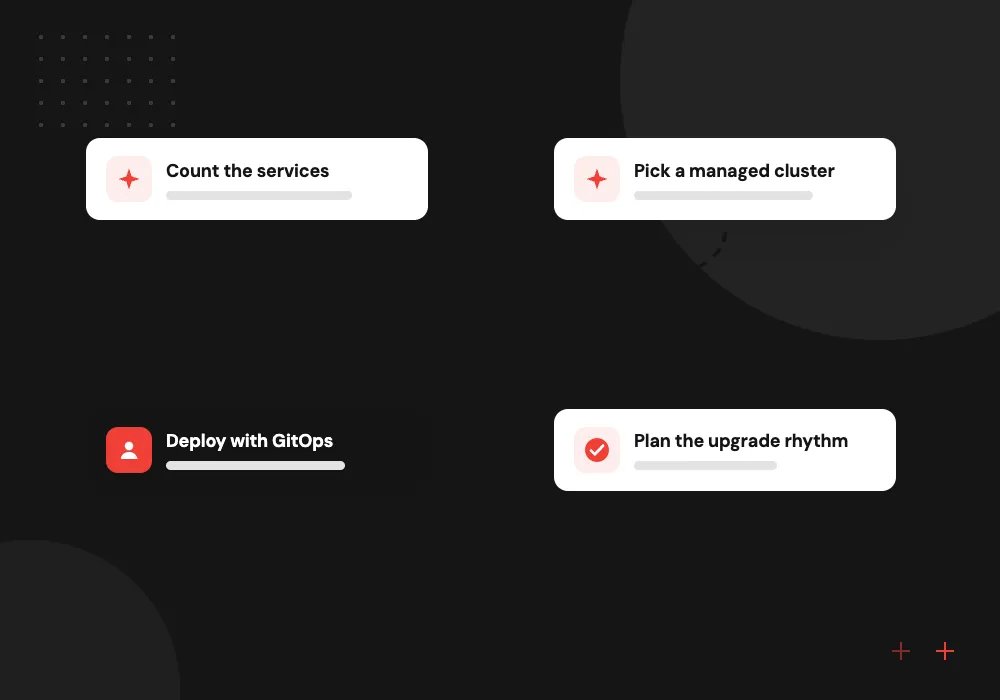
- 01 Count the services We list every app, worker and cron job, with its CPU and memory needs.
- 02 Pick a managed cluster EKS, AKS or GKE, matching the cloud you already pay for.
- 03 Deploy with GitOps Manifests or Helm charts in Git, applied by Argo CD or Flux.
- 04 Plan the upgrade rhythm Minor versions roll forward on a schedule, tested in staging first.
If two or three containers cover your needs, we recommend simpler hosting instead.
Kubernetes work we take on
Requests come from teams that have outgrown simple hosting, or that own a cluster nobody wants to touch.
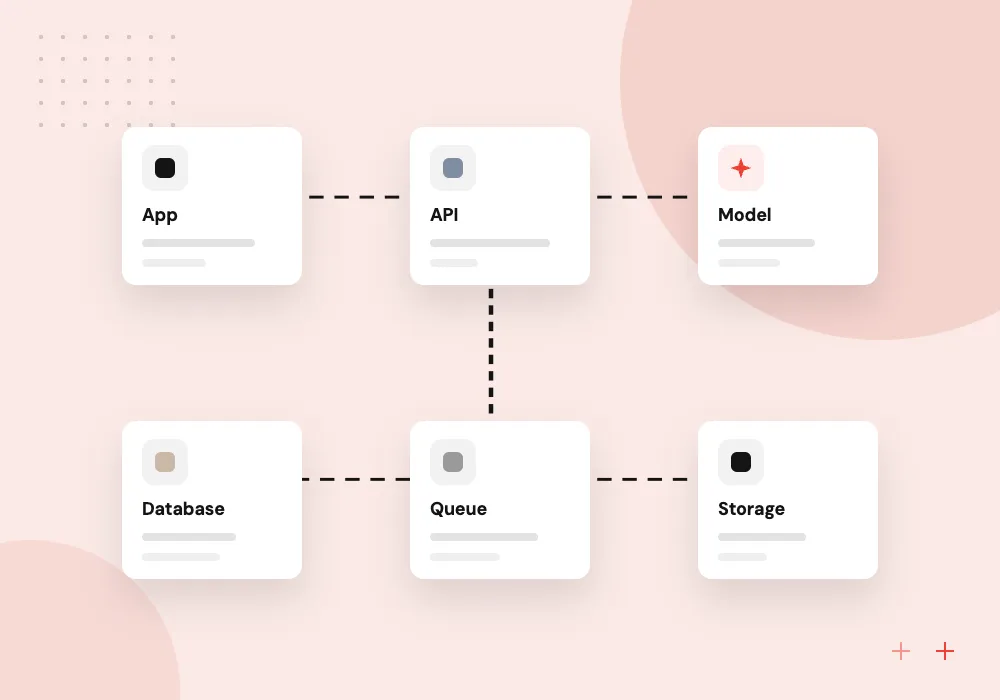
Managed Kubernetes setup
New clusters on EKS, AKS or GKE with node pools, ingress, certificates, autoscaling and logging, defined in Terraform so a second cluster is a copy.
Kubernetes migration from VMs
Apps on virtual machines or a Docker Compose host moved into the cluster one service at a time, with health checks and a rollback for each move.
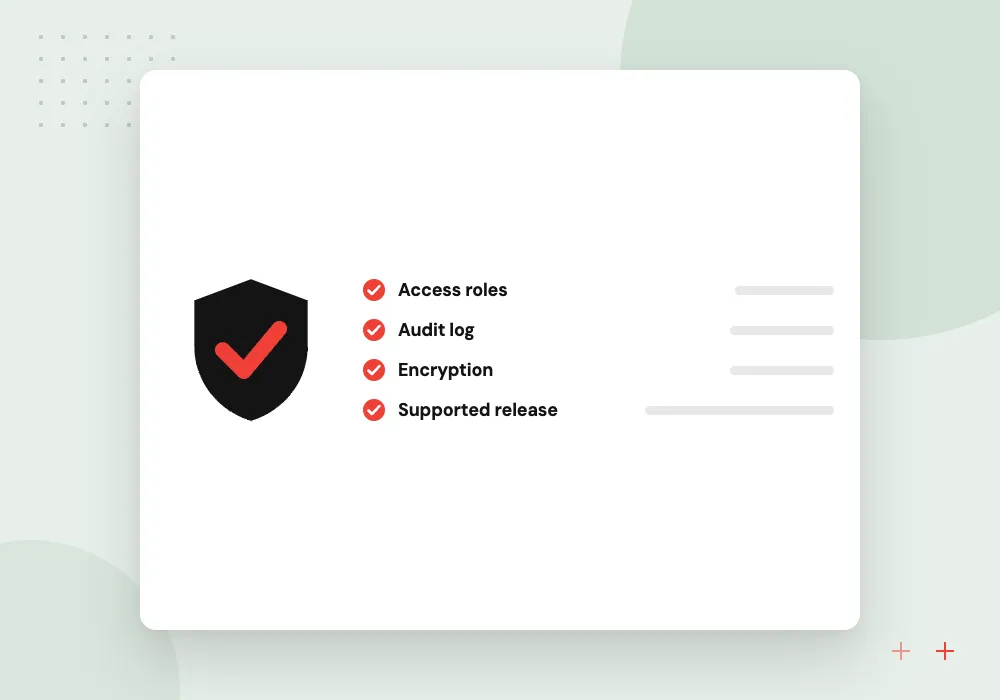
Upgrades and cluster rescue
Clusters stuck several versions behind brought back to a supported release, with deprecated APIs found and fixed before each step.
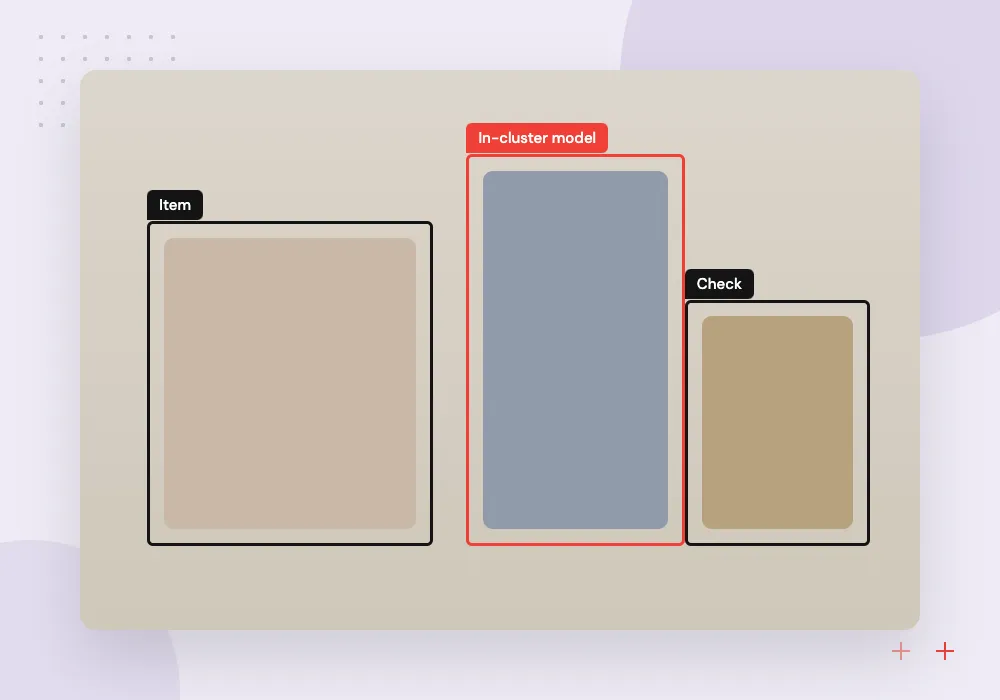
GPU nodes for AI models
Open-weight language or vision models served from GPU node pools inside your cluster, scaled down when idle and kept on your network when data is private.
Kubernetes migration, one service at a time
We do not move everything in one weekend. Each service gets a container image, health checks, resource limits and a Helm chart, then runs in the cluster beside the old host while traffic shifts over. Databases usually go to a managed database service rather than into the cluster, which keeps backups and failover simpler.
What we do
- Container images and Helm charts
- Readiness and liveness probes
- Ingress and certificate setup
- Traffic shift with a rollback path
- Old host retired after sign-off
Serving AI models on GPU nodes
For teams that want to run an open-weight model themselves, we add a GPU node pool, install the drivers and device plugin, and deploy a model server such as vLLM behind an internal endpoint. Where the provider supports it, the pool scales to zero nodes when no requests arrive.
What we do
- GPU node pool sizing
- Model server deployment and autoscaling
- Internal-only endpoints
- Latency and error dashboards
- Cost report per model

How we approach a project
Upgrades are where teams fall behind. The project patches only its three newest minor releases, as its release page shows, and providers retire old versions on their own schedules. We scan for deprecated APIs, upgrade staging first, then move production one node pool at a time.
A cluster can also host open-weight models on GPU nodes, next to the apps that call them. That suits firms whose data should stay on their own network, as described under private LLM deployment, and pairs with MLOps services for model versions and monitoring.
Kubernetes work is part of our cloud computing services, and microservices development covers how to split an application into the services a cluster runs.
How we work
- Kubernetes only when the workload needs it
- Every change applied from Git
- Scheduled upgrades, not emergency ones
Our Process
-

Workload and readiness review
We inventory services, traffic, state and current hosting, then recommend a cluster or something simpler.
-

Cluster design in Terraform
Node pools, networking, access, ingress, logging and backup tools are defined as code and reviewed with you.
-

Move services in waves
Low-risk services go first, and each wave ends with load checks and a rollback test.
-

Upgrade plan and handover
We leave a version calendar, runbooks and dashboards, and can run each upgrade cycle for you.
Why Aranv for Kubernetes
We may advise against it
If your workload fits simpler container hosting, the assessment says so and shows the cost difference, even when that means a smaller project for us.
Git is the source of truth
Cluster changes go through pull requests and a GitOps tool applies them, so nobody edits production by hand and every change has an author and a reason.
Security set at the cluster level
Role-based access, network policies, image scanning and Pod Security Standards are configured during setup, not bolted on after an incident.
Runbooks for your on-call staff
Plain steps for common events, such as a pod stuck restarting, a full disk, a failed upgrade or an expired certificate, so your team can act without calling us.
Planning Kubernetes Consulting Services?
Book a 30-minute conversation with the team that would build it.
Kubernetes consulting FAQs
-
Do we actually need Kubernetes?
Many small businesses do not. A few containers with steady traffic run more cheaply on a managed container service. Kubernetes makes sense with many services, several teams deploying on their own schedules, special networking, GPU workloads, or one platform across clouds.
-
What is managed Kubernetes and which provider should we pick?
With managed Kubernetes the cloud provider runs the control plane, while you manage workloads and worker nodes. EKS on AWS, AKS on Azure and GKE on Google Cloud are all capable. Choose the one in the cloud where your data and other systems already live.
-
How long does a Kubernetes migration take?
That depends on how many services you run, how much state they hold and how well they are packaged today. Stateless services move quickly; apps with file storage, sessions or scheduled jobs need more care. You get a wave-by-wave plan after the readiness review.
-
How often do Kubernetes clusters need upgrading?
More than once a year in practice. The project ships several minor versions a year and patches each for about a year, and providers end support on their own dates. Small, regular upgrades carry far less risk than jumping several versions at once.
-
Can we run AI models on our own Kubernetes cluster?
Yes, if the cluster has GPU nodes and the model’s license allows self-hosting. We deploy a model server, expose it only inside your network and measure speed and accuracy on your examples. For many tasks a hosted model API is still cheaper, and we compare both.

Let’s talk about your next step
Contact Aranv to discuss your workflow, current tools, and goals. Meet with our team or send an inquiry.
Book a meeting with our team
Choose an available date and time for a 30-minute conversation about your project.
Tell us about your project
Share a few details so we can discuss a useful next step.
Prefer email? sales@aranv.com