


What microservices development services include
Aranv provides microservices development services for US companies whose software has outgrown a single codebase: service architecture design, a staged monolith to microservices migration, event-driven services on queues and containers, and separate AI services that can scale and change without touching the core system.
Microservices make sense when several teams need to release on their own schedules, when one part of the system needs far more capacity than the rest, or when a component must use a different language. For a single small team, a well-structured modular monolith is usually cheaper to run and easier to debug, and we often recommend it first.
Service architecture. Each service gets an owner, its own database or schema, a published API or event contract, and health checks. We add a gateway, central logs, OpenTelemetry tracing, and retries with timeouts so one failing service is less likely to drag others down. Services usually run in Docker containers on Kubernetes or a managed container platform.
Splitting a monolith safely
One service out at a time
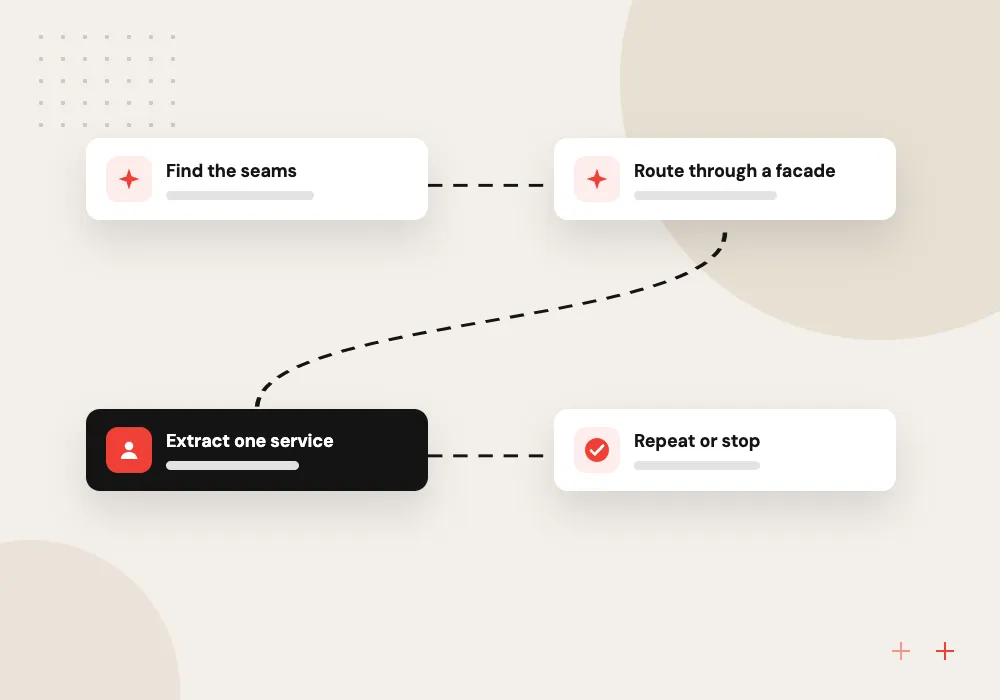
- 01 Find the seams We map modules, shared tables and internal calls to spot natural boundaries.
- 02 Route through a facade A proxy sends each endpoint’s traffic to old or new code.
- 03 Extract one service The first service gets its own data, pipeline and alerts.
- 04 Repeat or stop Each extraction is reviewed, and some parts stay in the monolith.
This is often called the strangler fig pattern: new services grow around the old system until parts of it can be removed.
Microservices work we take on
Microservices solve real problems for some teams and create new ones for others. Our work starts by working out which group you are in.
Service architecture design
Boundaries, data ownership, sync and async calls, and failure handling written down before any code is split.
Monolith to microservices
Busy or fast-changing parts of a large application pulled out one at a time behind a routing layer.
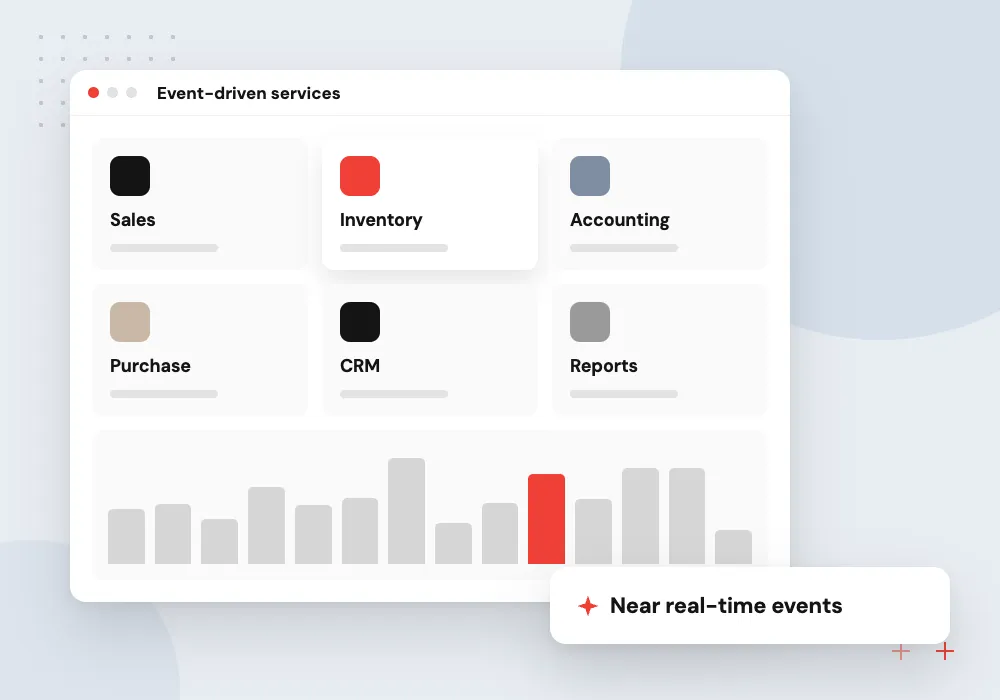
Event-driven services
Services that publish and consume events on Kafka, RabbitMQ or a cloud queue, so orders, stock and invoices stay in step.
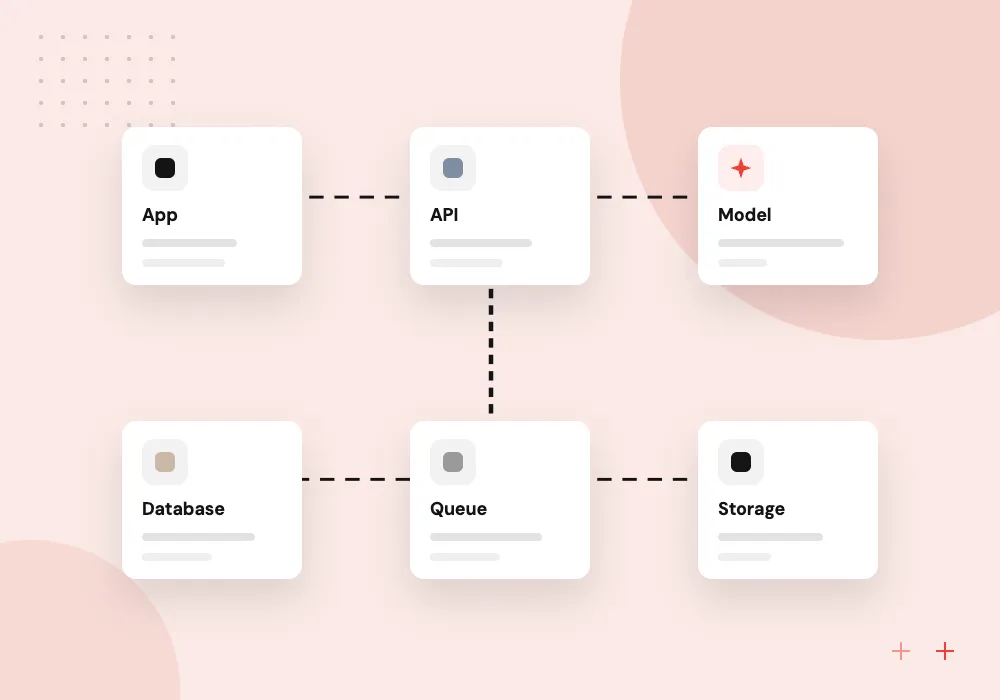
Separate AI services
Model calls, document parsing and embeddings run in their own service, scaled and billed apart from the core application.
Monolith to microservices, one piece at a time
A full rewrite into services is the riskiest way to modernize. We take the strangler route instead: a routing layer goes in front of the monolith, one well-bounded area such as billing or notifications moves into its own service, and traffic shifts over as tests pass. The rest keeps running as before.
What we do
- Dependency and data ownership map
- Routing layer in front of the monolith
- First service with its own database
- Data sync during the transition
- Rollback path for each extraction
AI as a service of its own
Model calls behave differently from the rest of your system: they are slow, priced per token and change often as providers release new models. Running them in a separate service keeps that churn away from core code. The core sends a request, and the AI service handles prompts, retrieval and checks before replying or publishing an event.
What we do
- Dedicated AI service and API
- Queue for long document jobs
- Provider keys held in one place
- Cost and latency per caller
- Evaluation tests on model changes

How we approach a project
Monolith to microservices. We extract services in stages behind a routing layer, so users keep working in one application while the code behind it changes. Our modernization strategy guide covers the wider choices, and NIST’s SP 800-204 is a useful reference for securing the result.
We build services in Java, Go, Node.js, Python or .NET, depending on who will run them. Pipelines and monitoring come from our DevOps practice, and the remaining stacks sit under technologies.
How we work
- Split only where teams need it
- Each service owns its data
- Tracing before the second service
Our Process
-

Architecture review
We study the code, data model, deploy process and team setup, and say plainly whether splitting will help.
-

Platform groundwork
CI pipelines, container hosting, logging, tracing and a routing layer are ready before the first service moves.
-

Extract the first service
We pick a part with clear boundaries and real benefit, move it and run it in production with full monitoring.
-

Review and continue
After each extraction we compare release speed, error rates and costs with you and decide whether the next is worth it.
Why Aranv for microservices
We may advise against it
If a modular monolith will serve you better, the architecture review says so and shows the reasoning, even though it means less work for us.
Platform before services
Logging, tracing, pipelines and routing are in place before the first extraction, so faults in a distributed system can be traced quickly.
Data ownership settled early
We decide which service owns each table before code moves, which avoids the shared-database tangle that undoes many migrations.
Each step reviewed with you
After every extraction we compare release speed, errors and hosting costs with you before agreeing the next one.
Planning Microservices Development Services?
Book a 30-minute conversation with the team that would build it.
Microservices FAQs
-
Do we need microservices or is a monolith fine?
A monolith is fine for most small teams. Consider microservices when several teams block each other’s releases, when one part must scale very differently, or when one area changes far more often than the rest. A modular monolith is a sensible middle step.
-
How long does a monolith to microservices migration take?
It runs in stages, so the first extracted service can reach production long before the migration ends, and some systems stop after a few services. Pace depends on how tangled the code and database are and how much platform work is needed. We estimate one extraction at a time.
-
Do microservices cost more to run than a monolith?
Usually, because each service needs hosting, monitoring and its own pipeline. The difference depends on the number of services, traffic, the container platform and the observability tools. We include running costs in the architecture review so the decision is made with them in view.
-
How do microservices share data like customers or orders?
Each service owns its data, and others reach it through an API or through events. For data many services need, one service is the source of truth and publishes changes. Work that spans services uses patterns such as sagas, with compensating steps when something fails.
-
Where do AI features fit in a microservices architecture?
Usually as their own services: one for model calls and prompts, one for document parsing, one for embeddings and search. They scale with AI demand, keep provider keys in one place, and can switch model or provider without redeploying the core system.

Let’s talk about your next step
Contact Aranv to discuss your workflow, current tools, and goals. Meet with our team or send an inquiry.
Book a meeting with our team
Choose an available date and time for a 30-minute conversation about your project.
Tell us about your project
Share a few details so we can discuss a useful next step.
Prefer email? sales@aranv.com