


What AI route optimization covers
Aranv builds AI route optimization for distributors, food suppliers and field service companies: software that assigns orders and jobs to vehicles, sequences every stop around time windows, capacity and driver hours, predicts real service times from your records, and sends the plan to a dispatch board and a driver app.
Route planning is a combination problem: which vehicle visits which stops, in what order, within whose shift. AI route optimization pairs a routing solver, such as the open-source Google OR-Tools, with models trained on your delivery records that predict travel and service times, so the plan reflects how long work actually takes.
Inputs come from your order system or ERP: addresses, time windows, weights, service durations and priorities. We clean and geocode addresses first, because a pin on the wrong side of a highway ruins a route. Vehicle and driver data can come from fleet management software or a field service platform.
From tomorrow’s order list to routes drivers can run
How a day of routes is planned
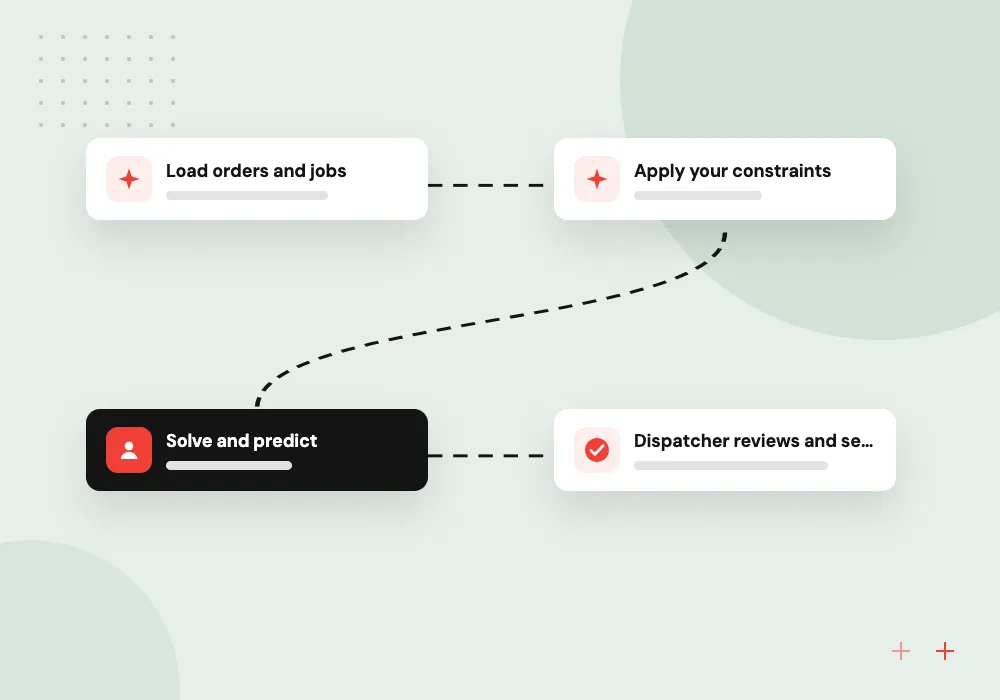
- 01 Load orders and jobs Addresses, time windows, weights and service needs come from your ERP or job system.
- 02 Apply your constraints Vehicle capacity, driver shifts, skills, dock hours and legal driving limits are set.
- 03 Solve and predict A routing solver builds routes using travel and stop times learned from history.
- 04 Dispatcher reviews and sends The dispatcher adjusts, locks stops, then releases routes to drivers’ phones.
When jobs change during the day, the remaining stops can be re-planned without disturbing completed ones.
Route and dispatch problems we solve
Once you run more than a few vehicles, the number of possible routes outgrows any whiteboard.
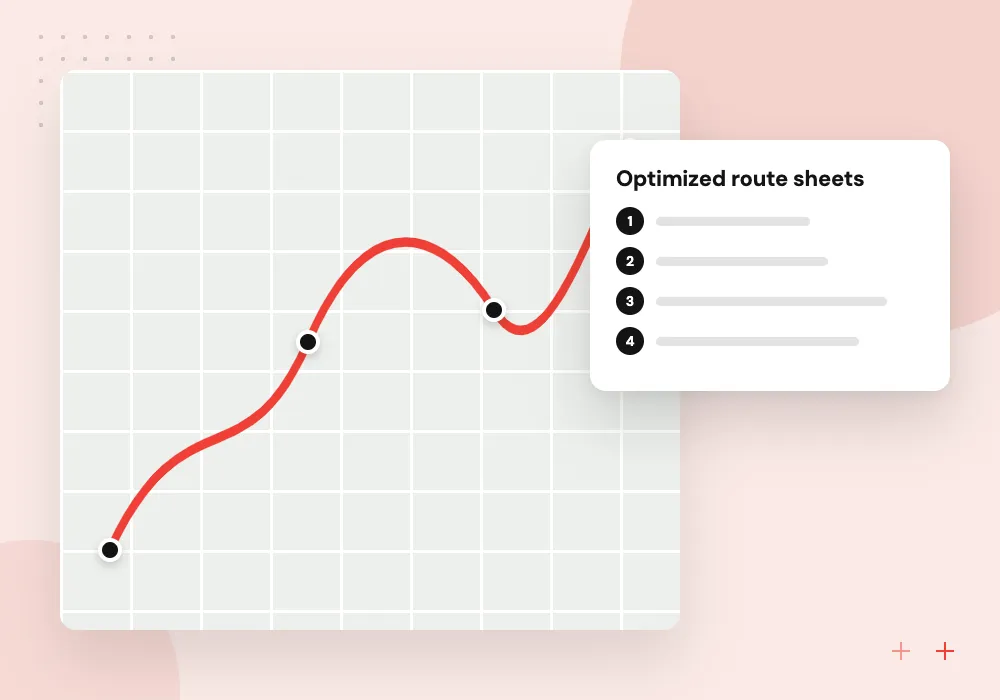
Daily delivery route planning
Tomorrow’s orders assigned to trucks and sequenced stop by stop, respecting customer time windows, vehicle capacity, driver shifts and loading dock hours.
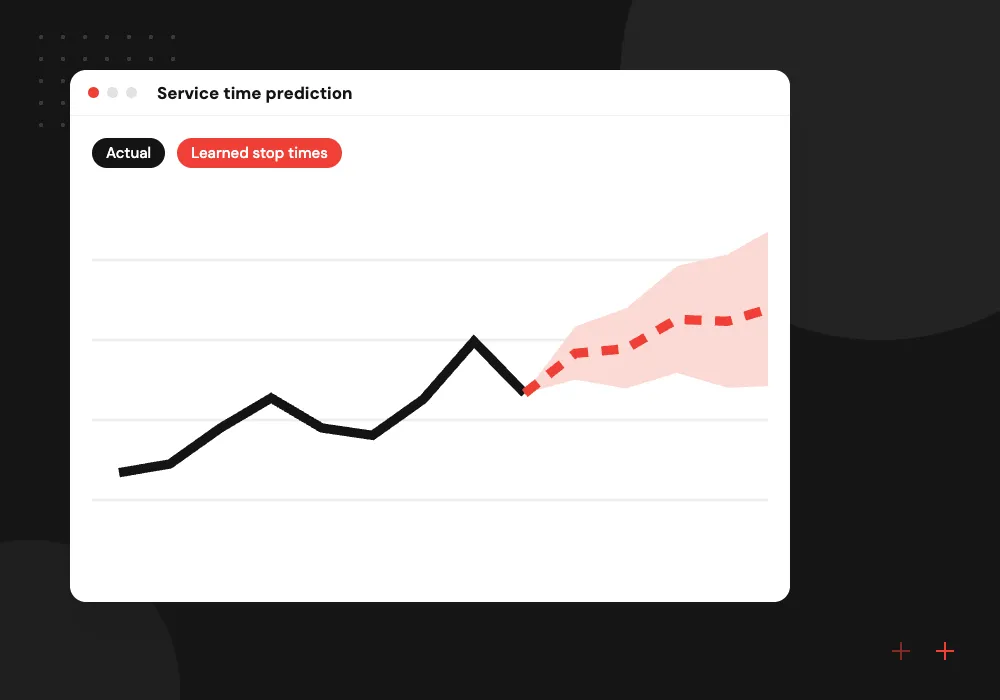
Service time prediction
A model learns how long each stop really takes by customer, order size and site, so plans stop assuming the same fixed minutes everywhere.
Same-day dispatch optimization
When a job is added or canceled, or a truck breaks down, the dispatcher gets re-planned routes for the remaining stops to accept or adjust.
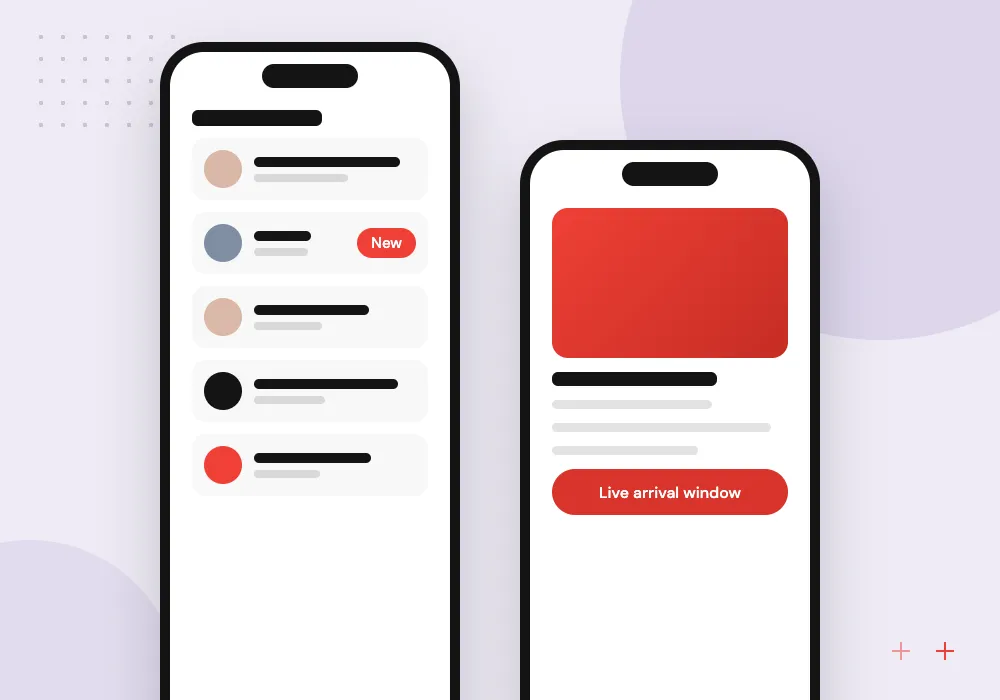
Customer arrival windows
Customers get an arrival window by text or email, updated from driver progress, so fewer calls reach the office asking where the truck is.
Constraints that match your operation
A route that ignores a dock’s receiving hours or a driver’s license class will not survive the morning. We capture your real rules before solving: time windows, weight and pallet limits, refrigerated loads, driver skills, break rules and federal driving limits for the drivers they apply to.
What we do
- Time windows and dock hours
- Weight, volume and pallet capacity
- Driver skills and license classes
- Hours-of-service and break rules
- Fixed stops and preferred drivers
Dispatch board and driver app
Plans reach people through two screens. Dispatchers can lock a stop to a driver, drag a job between routes and re-run the solver on what is left. Drivers see stop order, delivery notes and navigation, and capture a photo or signature at each stop.
What we do
- Dispatch board with drag and drop
- Stop locking and manual overrides
- Driver app with navigation links
- Photo and signature proof of delivery
- Planned versus actual reports

How we approach a project
Routes reach drivers through a mobile app and the office through a dispatch board, and completed stops flow back to the ERP for invoicing. For drivers covered by federal hours-of-service rules, remaining drive and duty time are hard limits in the plan. Our AI software development team builds the full system, from solver to app.
Distributors, food suppliers and home service firms are the usual users; see AI for logistics and supply chain and home service businesses. Send us a day of real orders ahead of a 30-minute conversation and we will walk through what a plan for it could look like; times are listed on our contact page.
How we work
- Plans built on your real stop times
- Constraints captured before any solving
- Dispatchers keep the final call
Our Process
-

Ride along and record rules
We spend time with dispatchers and drivers to capture the unwritten rules, such as customers who refuse early deliveries.
-

Replay past days
Historic order days are planned by the solver and compared with the routes your team actually ran, mile for mile.
-

Pilot one depot or region
Dispatchers use the new plans for one location while drivers give feedback on stop order and timing.
-

Tune and expand
Stop-time models are retrained on pilot data, constraints are adjusted, and the system rolls out to the remaining depots.
Why Aranv for routing work
Unwritten rules captured first
We ride along and sit with dispatchers to record the habits no system holds, such as gate codes, lunch closures and customers who only accept one driver.
Stop times from your records
Service times are learned from completed stops by customer and order size, so the plan stops promising arrivals that your drivers cannot meet.
Dispatchers stay in control
Every plan is a proposal. Dispatchers lock, move and re-run stops, and their changes are logged so we can see which rules the model is still missing.
Connected to billing
Completed stops, proof of delivery and failed deliveries flow back to your ERP, so invoicing and redelivery start from the same record.
Planning AI Route Optimization?
Book a 30-minute conversation with the team that would build it.
AI route optimization FAQs
-
How is AI route optimization different from Google Maps directions?
Directions find the best path between points you have already ordered. Route optimization decides which vehicle takes which stops and in what sequence, under capacity, time window and shift limits, then uses map data for travel times. It solves the assignment problem that directions apps leave to you.
-
Can delivery route planning respect federal hours-of-service limits?
Yes. For drivers subject to FMCSA rules, driving and on-duty limits become hard constraints. Where your electronic logging devices expose remaining hours, the plan uses each driver’s actual clock rather than a full fresh shift.
-
Will it work with our current dispatch or ERP system?
Usually. We read orders and write routes back through the system’s API or a scheduled file exchange. If dispatch currently lives in spreadsheets, we add a simple dispatch board as part of the project rather than asking you to buy another product first.
-
How fast can routes be re-planned during the day?
Solving time depends on the number of stops and constraints. We set a time limit so dispatchers get a good plan quickly, and re-planning only touches stops not yet started, so drivers already on the road are not shuffled without reason.
-
What do drivers need to use it?
A smartphone with the driver app, which shows stop order, notes, navigation links and proof-of-delivery capture. Drivers can mark a stop as failed with a reason, which feeds both the dispatcher and the next round of stop-time training.

Let’s talk about your next step
Contact Aranv to discuss your workflow, current tools, and goals. Meet with our team or send an inquiry.
Book a meeting with our team
Choose an available date and time for a 30-minute conversation about your project.
Tell us about your project
Share a few details so we can discuss a useful next step.
Prefer email? sales@aranv.com