


How to weigh building against buying
Aranv’s view on build vs buy AI: buy an off-the-shelf tool when the task is common and the product already fits your systems and data rules, and build custom AI when the task depends on your own process, data or integrations. Many companies buy first and build around the gaps.
Start with what you already pay for. CRMs, helpdesks, office suites and accounting tools now include AI features, and switching one on may cover the need. If not, a specialist product may fit. Building makes sense when neither matches the task, or when the task is part of what sets your business apart. Our AI consulting work often begins with that inventory.
Buying brings a faster start, a vendor who maintains the model and a subscription instead of a project budget. Its costs appear later, as per-seat fees grow, workarounds pile up or terms change. Building reverses that: more effort up front, then a system shaped to your process. AI software development covers that path, and our guide on picking an AI development partner helps with selection.
A quick test for any AI tool decision
Buy, configure or build
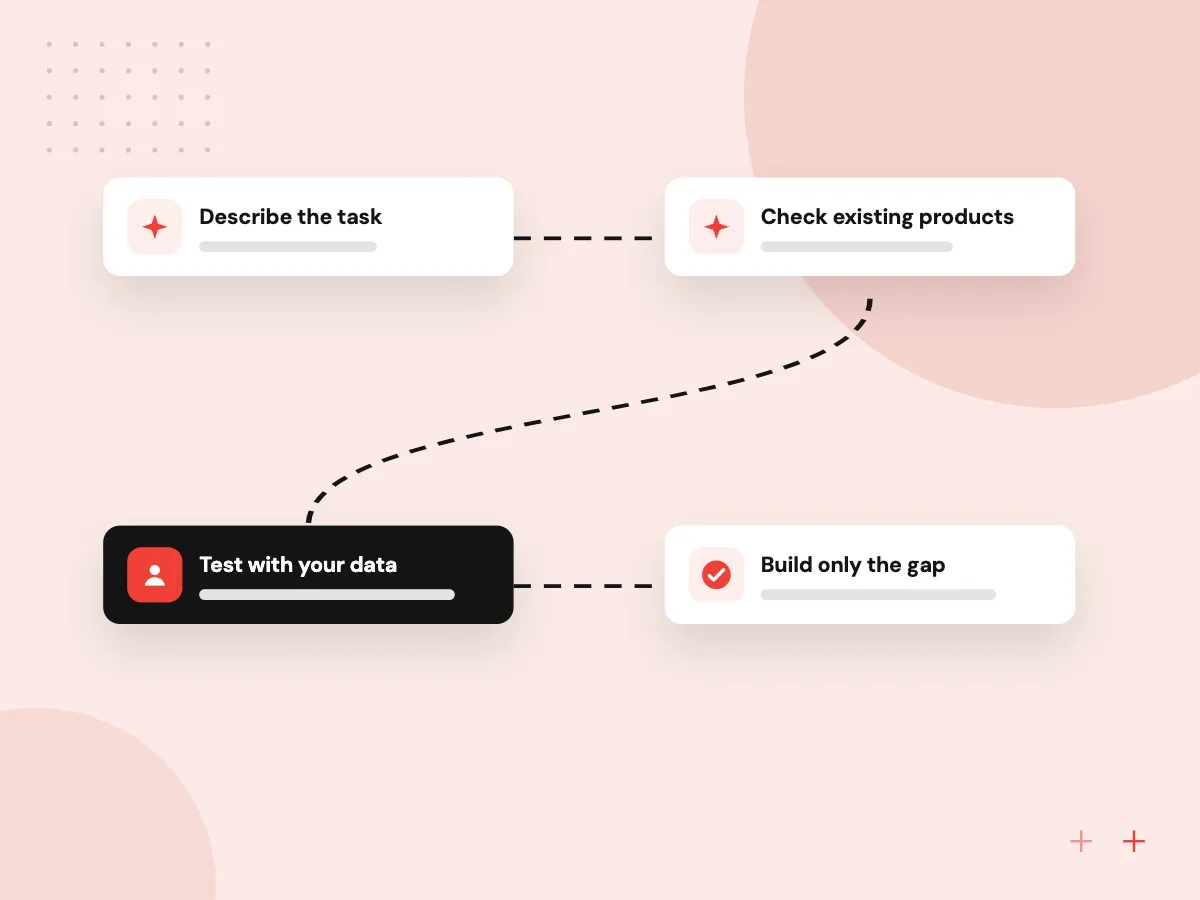
- 01 Describe the task Write the job in one line, with its inputs, its output and the system it updates.
- 02 Check existing products Look first at AI options inside software you already license, then at specialist tools.
- 03 Test with your data Trial the strongest product on real documents or tickets, not the vendor’s demo set.
- 04 Build only the gap Custom work covers what no product handles, connected to what you bought.
Configuring a product you already own is the middle option; check it first.
Custom AI vs off-the-shelf: four tests
Feature lists rarely settle the question. These four points usually do.
How standard the task is
Meeting notes, grammar help and general support chat are well served by products. Pricing rules, quoting or underwriting specific to your firm usually are not.
Where your data must live
Products process data under their own terms and regions. A custom build can run in your cloud account with your retention and access rules.
How deep the integration goes
A product with a ready connector to your CRM is simple. A task spanning an older ERP, a shared drive and email often needs custom code.
Who owns the result
With a product, prompts, settings and history live in the vendor’s platform. With a custom build, code, prompts and evaluation data can be yours under contract.
The case for buying
A good product brings a maintained model, a support team and features you did not have to design. It suits common work such as summarizing meetings, drafting emails and answering routine help-center questions. Trial it with your own files and read the data terms before rollout.
What we do
- Faster start with less setup
- Vendor handles model updates
- Predictable subscription fees
- Trial on your own files
- Check export and exit terms
The case for building
Custom AI fits work that depends on your rules, documents and systems. It can run in your own cloud account, follow your approval steps and change when your process does. It needs a clear scope, an owner on your side and a support plan after launch.
What we do
- Shaped to your process
- Runs under your data rules
- Connects older and newer systems
- Code and prompts you own
- Changes on your schedule

How we approach a project
A hybrid is the most frequent answer. You keep a bought product for the common work and build what it lacks: a connector, a review step, a model call wired into your ERP. LLM integration and AI workflow automation are where that custom layer usually lives.
Either way, treat outside AI as part of your supply chain. The NIST AI RMF core gives third-party software and data a category of its own. Ask any vendor what happens to your data, how model changes are tested and how you would leave.
How we work
- Buy common work, build what differentiates
- Test every option on your data
- Plan the exit before signing
Our Process
-

Summarize the task
Note the job, its weekly volume, the systems involved and the data rules that apply.
-

Shortlist two products
Include AI features in tools you already own, then trial both on a sample of real work.
-

Price a custom option
Ask for a scoped estimate of the same task built and connected to your systems.
-

Compare total cost of ownership
Weigh fees, build cost, support, staff time and switching cost over the same period, not just the first invoice.
How Aranv helps you decide
We check what you own first
Before proposing a build, we review the AI features in tools you already license and tell you if one of them covers the task.
Side-by-side trials on your data
We help you test a product and a prototype on the same sample of real work, so the comparison reflects your own documents and edge cases.
Custom only where it adds value
When a hybrid fits, we build the connector, review step or model call the product lacks and leave the rest to the product.
Exit plans in both directions
We document data exports for bought tools and hand over code and prompts for custom ones, so neither choice locks you in.
Ready to act on this guide?
Ask our team in a 30-minute conversation.
Or see how we build it: Explore all services
Build vs buy AI FAQs
-
Is it cheaper to build or buy AI software?
Buying is usually cheaper to start. Building can cost less over time when per-user fees are high, the product needs costly workarounds or you need features no product offers. Compare subscription fees, build and support costs, staff time and the cost of switching later over the same period.
-
When does custom AI make sense for a small business?
When the task is tied to how your business works, such as quoting from your price rules or reading your own forms, when it must connect systems no product links, or when data rules prevent sending records to a third party. If a product does the job well, buy it.
-
Can we start with an off-the-shelf tool and build later?
Yes, and it is often a sensible path. A product shows how staff use AI and where it falls short. Keep exports of your data and settings, and never store the only copy of key records inside the tool, so a later move stays simple.
-
What should we check before buying an AI product?
Where data is processed and stored, whether it is used for training, how long logs are kept, which model powers the product and how changes are announced, what admin controls exist, and how you export everything if you leave.
-
Who owns a custom AI system after it is built?
Ownership is set in the contract. We recommend terms under which code, prompts, evaluation sets and documentation pass to you once paid for. The underlying model usually stays with its provider unless you run an open-weight model yourself.

Let’s talk about your next step
Contact Aranv to discuss your workflow, current tools, and goals. Meet with our team or send an inquiry.
Book a meeting with our team
Choose an available date and time for a 30-minute conversation about your project.
Tell us about your project
Share a few details so we can discuss a useful next step.
Prefer email? sales@aranv.com