


How to build an MVP step by step
Aranv’s short answer on how to build an MVP: pick one user and one problem, write down the riskiest assumption, build only the features needed to test it, release to a small group of real users, then measure what they do and decide whether to continue, change course or stop.
An MVP is the least you can build that still gives real users one real result, so you learn whether the idea deserves more money. A prototype only shows how something might look, and a proof of concept only tests whether a technology works. Our MVP development service builds the first version; this guide covers the decisions around it.
Scope is where first products go wrong. List every feature you want, then mark the ones a first user cannot do without, and build only those. Payments, admin screens and reports can often be handled by hand at first. A progressive web app keeps one codebase, and the native vs cross-platform guide helps when a store app is required.
The learning loop behind a first product
One assumption, one release, one decision
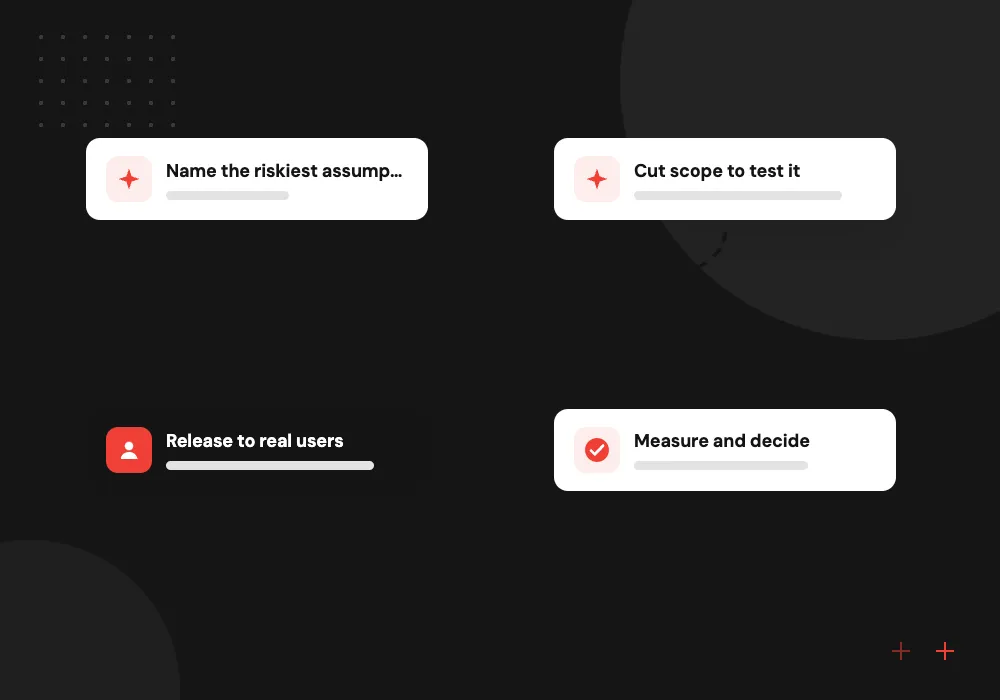
- 01 Name the riskiest assumption Write down the belief that would sink the product if it were wrong.
- 02 Cut scope to test it Keep only what a first user needs to reach the core result.
- 03 Release to real users Put it before a small group who have the problem today.
- 04 Measure and decide Let what users did, not what they said, settle the next step.
Some MVPs need little code: a form, a sheet and a person.
Four MVP steps that matter most
These habits keep version one small enough to learn from.
Pick one user and problem
Choose a narrow group with a painful, frequent problem, such as dispatchers rebooking missed jobs, rather than everyone who might one day use the product.
Write the core path
Describe the single route from sign-up to the result the user came for, then cut every feature that does not sit on that route.
Choose the lightest platform
A responsive web app or progressive web app often tests demand faster than native apps, unless the idea depends on phone hardware or store presence.
Fake the AI first
For an AI product, a person can stand in for the model behind the screen for the first users, showing whether the output is wanted before you build the pipeline.
Cutting MVP scope without losing the point
Write the core path as a short story: who arrives, what they do and what they get. Every feature either sits on that path or waits. Admin tools, reports and edge cases can often be handled by staff behind the scenes until real use shows which ones deserve code.
What we do
- One-sentence core path
- Must-have feature list
- Manual steps behind the scenes
- Analytics on the key action
- Written list of what waits
Building an AI MVP responsibly
AI makes a first version feel finished sooner than it is. Before launch, test the model on real inputs, decide what a wrong answer costs and give users a clear way to flag mistakes. Keep a person reviewing outputs until the error rate is measured.
What we do
- Test set from real inputs
- Clear AI disclosure to users
- Flag button on every answer
- Human review of early outputs
- Usage and cost per request

How we approach a project
Decide the measurement before launch: which action shows the product works, how many users should take it and by when. Talk to users weekly and log what you changed and why. App stores add their own steps; newer personal developer accounts on Google Play, for example, must run a closed test before production.
AI products need one more check: whether people trust and use the output. An AI MVP should log every answer, let users flag bad ones and keep a person in the loop until accuracy is measured. If the problem itself is still fuzzy, a software discovery phase comes first, and our buyer guides cover other planning choices.
How we work
- One user, one problem first
- Measure behavior, not opinions
- Plan release two after release one
Our Process
-

Interview target users
Talk with a handful of people who have the problem now and note how they solve it today.
-

Define success in numbers
Pick the one action that proves value and the level of use that would justify a second release.
-

Build the core path only
Develop the fewest screens and integrations that deliver that action, with basic analytics from day one.
-

Launch small, review weekly
Release to an invited group, watch the data, interview users weekly and decide after a set period.
How Aranv helps build MVPs
Scope argued down, not up
We push features out of the first release and suggest manual workarounds, because a smaller build reaches users sooner and teaches more.
Measurement built in
Analytics on the core action and a simple feedback channel ship with release one, so the decision after launch rests on data.
A code base that can grow
Even a small first version gets tests, documentation and a sensible structure, so a successful MVP does not need a rewrite.
Accounts in your name
App store, cloud and analytics accounts are created under your company from the start, so you control the product.
Ready to act on this guide?
Ask our team in a 30-minute conversation.
Or see how we build it: Explore all services
MVP questions
-
What is the difference between an MVP and a prototype?
A prototype shows how a product might look and flow, and people try it in a test setting. An MVP is working software real users rely on for a real result, so you can measure behavior. Many teams prototype first, then build the MVP.
-
How many features should an MVP have?
As few as it takes for a first user to reach the core result. A simple test: if removing a feature would stop a user getting that result, keep it; if not, cut it or handle it by hand for now.
-
How long does an MVP take to build?
That depends on user roles, integrations and platforms. A web app with one role and few integrations moves much faster than a marketplace with payments and two mobile apps. Fixing scope and the success measure early shortens the build more than anything else.
-
Should an MVP be a mobile app or a web app?
Start on the web unless the product depends on phone hardware, background location or a place in an app store. A responsive web app or PWA reaches every device from one codebase and is quicker to change after feedback.
-
What should we measure after launching an MVP?
The core action: how many invited users complete it, how many come back and repeat it, and where they drop out. Add short interviews to learn why. Downloads and sign-ups alone say little about whether the product solves the problem.

Let’s talk about your next step
Contact Aranv to discuss your workflow, current tools, and goals. Meet with our team or send an inquiry.
Book a meeting with our team
Choose an available date and time for a 30-minute conversation about your project.
Tell us about your project
Share a few details so we can discuss a useful next step.
Prefer email? sales@aranv.com